
Mastering Digital Marketing Strategies: A Comprehensive Guide
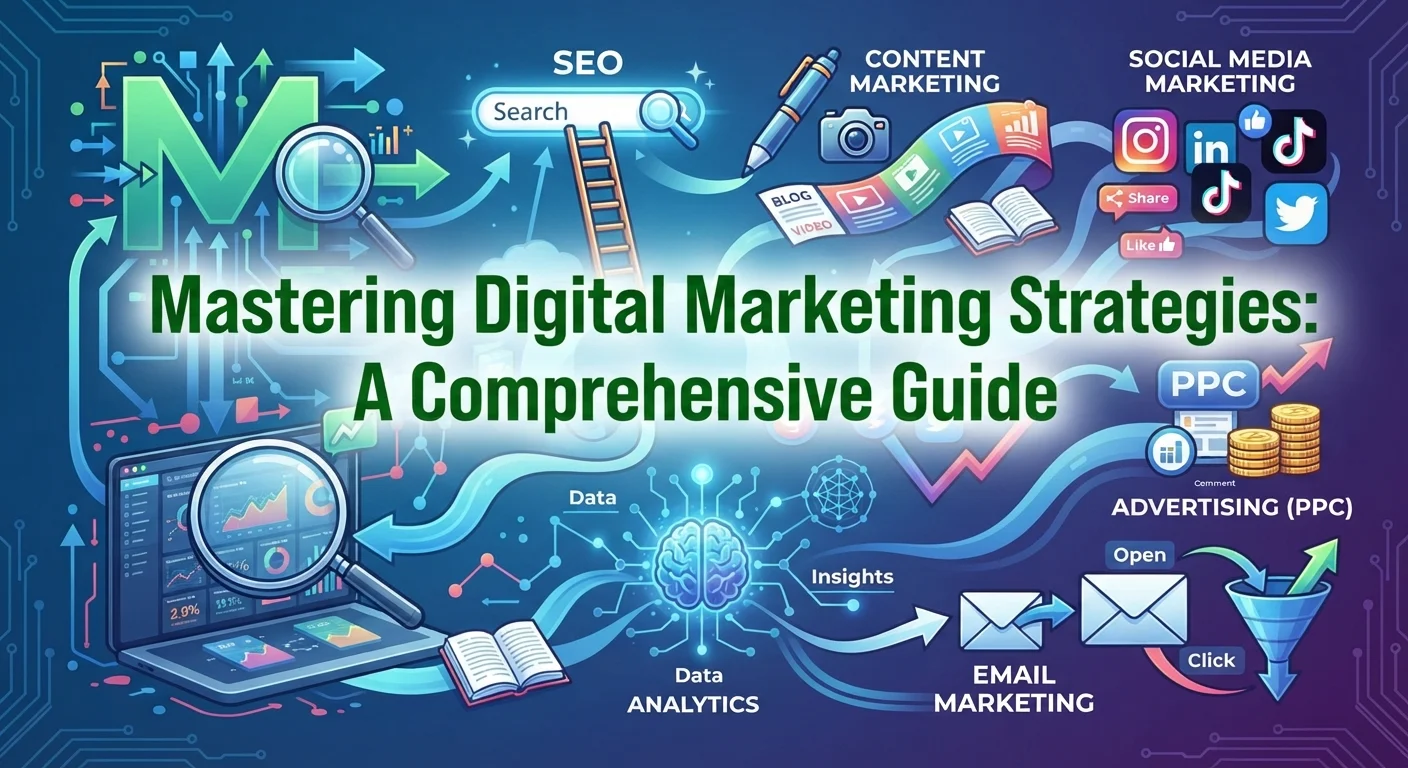
Digital Marketing Strategies: How to Build a Plan That Generates Customers
A digital marketing strategy is a plan for using online channels to reach a specific audience and achieve a measurable business goal. It should connect your customer’s problem to the right message, channel, landing page, and conversion action—not simply post content across every platform.
This guide explains how to build a practical digital marketing strategy for a small business, local service company, ecommerce store, or B2B organization.
Start With a Business Goal
Every strategy should begin with a measurable business outcome. “Increase brand awareness” is useful, but it becomes actionable when you define the target audience, channel, timeframe, and result.
Examples of clear goals include:
- Generate 30 qualified consultation requests per month
- Increase online orders by 20% over the next quarter
- Book 15 product demos per month
- Grow an email list by 500 relevant subscribers
- Increase repeat purchases among existing customers
- Reduce cost per qualified lead from paid ads
Choose one primary goal for the next 90 days. Trying to pursue awareness, leads, sales, retention, and referrals at the same time often dilutes focus and budget.
Understand Your Ideal Customer
A strategy works when it speaks to a specific customer’s problem, priorities, and buying process. Avoid defining your audience only by age or gender.
Document:
- Who they are and where they are located
- The problem they want solved
- What they currently use as an alternative
- What information they need before buying
- Which channels they use to research and buy
- Common objections, such as price, trust, delivery, or implementation time
For example, a Nairobi dental clinic may target busy professionals searching for “dentist near me,” while an online fashion store may target young shoppers who discover products through Instagram and TikTok.
Define Your Value Proposition
Your value proposition explains why someone should choose your business. It should be specific, credible, and easy to understand.
Use this format:
We help [specific customer] achieve [specific result] through [specific product or service].
Examples:
- “We help small restaurants increase online orders through local SEO and Google Ads.”
- “We sell durable leather bags for professionals who commute daily.”
- “We help first-time founders launch a simple booking website.”
- “We provide virtual bookkeeping for Kenyan e-commerce sellers.”
Use this message consistently across your website, ads, social profiles, email campaigns, and sales conversations.
Map the Customer Journey
Customers rarely buy immediately. They move through stages of awareness, consideration, decision, and retention. Your strategy should provide the right content and call to action at each stage.
| Stage | Customer mindset | Best content or offer | Primary goal |
|---|---|---|---|
| Awareness | “I have a problem or interest.” | Blog post, short video, social post, ad | Attract relevant visitors |
| Consideration | “What are my options?” | Guide, comparison page, webinar, product page | Educate and build trust |
| Decision | “Is this the right choice?” | Case study, demo, consultation, pricing page | Generate a lead or sale |
| Retention | “Should I buy again?” | Onboarding, support, refill reminder, loyalty offer | Increase repeat revenue |
Identify where people drop off. A business may get traffic but few leads, or generate leads but fail to follow up quickly enough.
Choose the Right Channels
Do not choose channels based on trends alone. Choose them based on where your audience spends time and how they make buying decisions.
| Channel | Best for | Primary strength |
|---|---|---|
| SEO | Businesses with search demand for products, services, or information | Long-term organic visibility |
| Google Ads | High-intent searches and immediate lead generation | Fast visibility and measurable demand capture |
| Content marketing | Complex purchases, education, and trust building | Answers questions and supports SEO |
| Email marketing | Nurture, retention, repeat purchases, and promotions | Direct communication with interested people |
| Social media | Visual products, community, brand awareness, and discovery | Reach, engagement, and social proof |
| Paid social | New-product promotion, retargeting, and audience testing | Detailed audience targeting and creative testing |
| Local listings | Businesses serving customers in a specific area | Local search visibility and reviews |
Start with one or two primary channels. Add more only when you can measure results and manage the workload.
Build a Content Strategy
Content should answer real customer questions and guide people toward a relevant next step. Avoid publishing generic posts simply to fill a calendar.
Useful content formats include:
- How-to guides that solve a specific problem
- Comparison pages that explain options
- Buying guides and checklists
- Case studies with a clear process and result
- Frequently asked questions
- Product demonstrations or service explainers
- Customer stories and testimonials
For example, an accounting firm could publish “What documents do I need for tax filing in Kenya?” while a clothing store could publish “How to choose the right size when shopping online.”
Each piece of content should link to a relevant service, product, booking page, or lead-capture page.
Use SEO to Capture Search Demand
SEO helps your website appear when people search for relevant products, services, or information. It works best when each page targets a clear search intent.
- Research keywords and questions your customers use.
- Create dedicated pages for core services, products, and locations.
- Optimize title tags, headings, content, images, and internal links.
- Fix technical issues such as slow pages, broken links, and indexing problems.
- Track rankings, organic traffic, leads, and revenue in Google Search Console and analytics.
For a beginner-friendly introduction, read SEO for beginners.
Use Paid Ads to Accelerate Results
Paid advertising can generate visibility quickly, but it works best when your offer, landing page, and tracking are ready. Start with a small budget and one clear conversion goal.
- Use Google Ads for high-intent searches such as “emergency plumber near me” or “accounting software pricing.”
- Use Meta or TikTok ads for visual products, offers, and audience testing.
- Use LinkedIn Ads for B2B services and professional audiences.
- Send traffic to a relevant landing page, not a generic homepage.
- Track leads, sales, calls, bookings, and cost per acquisition.
For a detailed paid-search approach, read how Google Ads can help you advance your business goals.
Use Email to Nurture and Retain Customers
Email gives you a direct way to communicate with people who have shown interest. Use it to educate leads, recover abandoned carts, onboard customers, and encourage repeat purchases.
Useful email workflows include:
- Welcome sequence for new subscribers
- Lead-nurture sequence for people who download a guide or request information
- Abandoned-cart sequence for ecommerce stores
- Post-purchase onboarding and review requests
- Win-back campaign for inactive customers
For a step-by-step guide, read how to set up automated email sequences.
Use Social Proof to Build Trust
Customers are more likely to act when they see evidence that others have had a positive experience. Use proof throughout your website, ads, emails, and social content.
- Customer reviews and testimonials
- Case studies with clear results
- Client logos or recognizable partnerships
- Certifications, awards, or professional memberships
- Real product photos and customer-generated content
- Transparent guarantees, return policies, or warranties
Use specific proof rather than vague claims. “Helped a Nairobi dental clinic increase appointment bookings through local search” is more credible than “we get results.”
Create a Simple Marketing Funnel
A funnel connects traffic, content, lead capture, follow-up, and conversion. Start with one clear path rather than building several complicated funnels at once.
Example funnel for a service business:
- Run a Google Ads campaign for “SEO audit service Nairobi.”
- Send traffic to a landing page explaining the audit scope and benefits.
- Capture the lead with a short consultation-request form.
- Send an immediate confirmation email with next steps.
- Follow up within 24 hours to book a call.
- Track leads, consultations, proposals, and closed deals.
Example funnel for an ecommerce store:
- Use social media or paid ads to promote a product or collection.
- Send traffic to a product or category page.
- Encourage add-to-cart with clear photos, reviews, and delivery information.
- Recover abandoned carts with an automated email sequence.
- Track purchases, revenue, average order value, and return on ad spend.
Measure What Matters
Do not judge marketing only by likes, impressions, or website traffic. Track metrics connected to business results.
- Website visitors by source
- Leads, calls, bookings, or sales
- Conversion rate by channel and landing page
- Cost per lead or cost per acquisition
- Return on ad spend
- Email subscribers and revenue per email
- Repeat-purchase rate
- Customer lifetime value
Review performance weekly during a launch and monthly during normal operations. Invest more in the channels that produce profitable customers.
Create a 90-Day Marketing Plan
Days 1–30: Research and Setup
- Define your primary goal and ideal customer.
- Audit your website, analytics, and conversion tracking.
- Choose one or two primary channels.
- Create or improve your core landing page.
- Set up Google Search Console, analytics, and conversion tracking.
Days 31–60: Launch and Test
- Publish two to four useful content pieces.
- Launch a small paid-ads test.
- Start one email automation, such as a welcome sequence.
- Review traffic, leads, and conversion data weekly.
- Improve headlines, offers, or landing pages based on results.
Days 61–90: Optimize and Scale
- Pause channels or ads that do not produce qualified results.
- Increase budget for campaigns with acceptable cost per acquisition.
- Add a second email workflow, such as cart recovery or lead nurture.
- Collect reviews, testimonials, and customer feedback.
- Expand only into channels that support your primary goal.
Common Digital Marketing Mistakes
- Trying to use every platform at once.
- Running ads before the landing page and offer are ready.
- Tracking clicks instead of leads, sales, or revenue.
- Publishing content without a clear audience or call to action.
- Ignoring follow-up after a lead submits a form.
- Making frequent changes before enough data has accumulated.
Related Reading
To understand how SEO fits into a modern marketing strategy, read the biggest SEO trends for business websites.
To build a funnel that converts visitors into customers, read digital sales funnel blueprint.
To understand how paid advertising supports business growth, read how Google Ads can help you advance your business goals.
To improve customer retention and repeat purchases, read customer behavior analysis to increase online purchase rates.
Frequently Asked Questions
What is a digital marketing strategy?
A digital marketing strategy is a plan for using online channels to reach a specific audience and achieve a measurable business goal, such as generating leads, increasing sales, or improving retention.
Which digital marketing channel should I start with?
Start with the channel that matches your customer’s buying behavior. Local service businesses often benefit from Google Business Profile and Google Ads, while ecommerce stores may benefit from social media, SEO, and email automation.
How much should a small business spend on digital marketing?
There is no universal budget. Start with an amount you can test consistently, then increase spending only on channels that generate qualified leads or profitable sales.
How long does digital marketing take to work?
Paid ads can generate traffic quickly, but reliable optimization usually requires enough conversion data. SEO and content marketing often take longer to produce meaningful results.
Do I need to be on every social-media platform?
No. Choose one or two platforms where your audience spends time and where you can publish consistently.
What is the most important digital marketing metric?
Focus on the metric connected to your goal: qualified leads, bookings, sales, revenue, cost per acquisition, or customer lifetime value.