
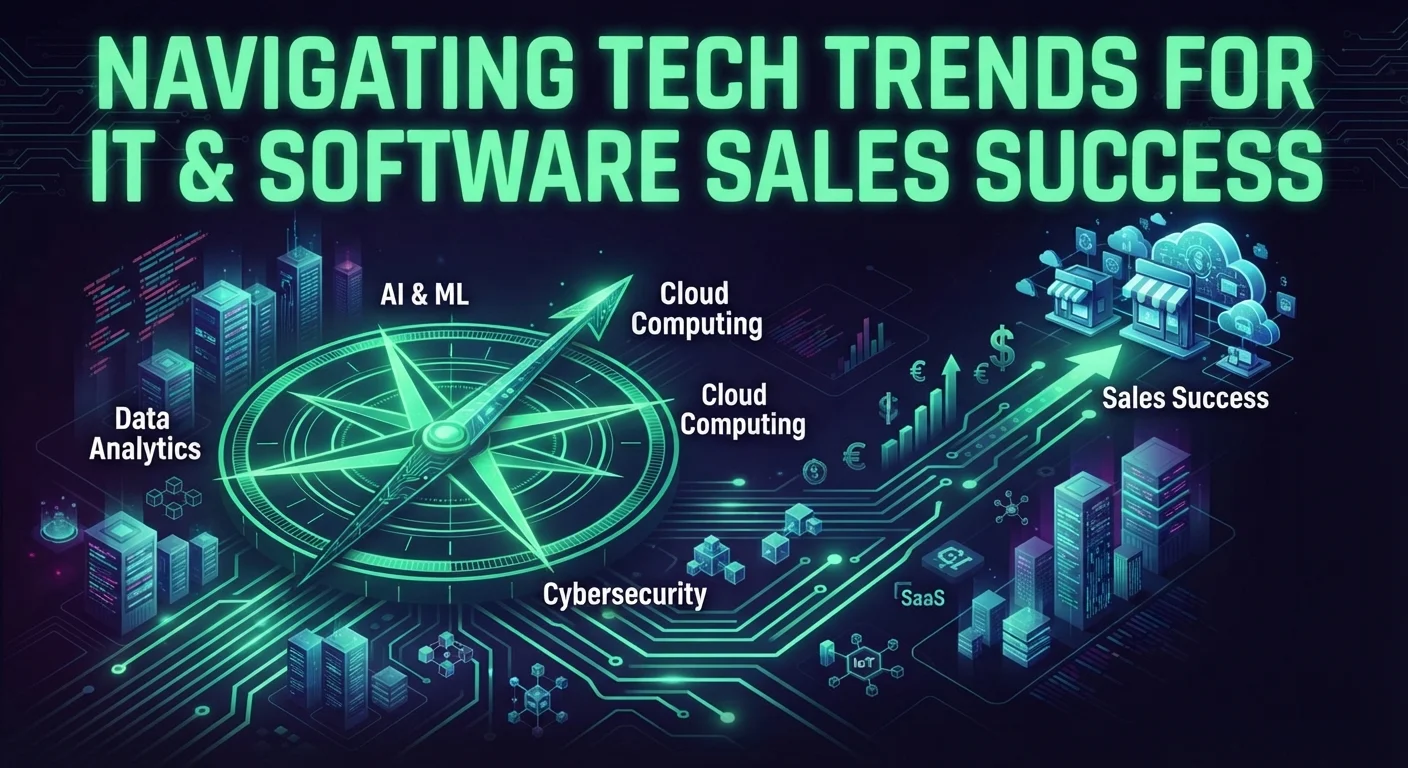
Navigating Tech Trends for IT & Software Sales Success
Sales and Marketing Strategy for IT Companies and Software Providers
IT companies and software providers often sell complex products with long decision cycles, multiple stakeholders, and high customer expectations. A successful sales strategy therefore needs more than advertising—it requires a clear ideal customer profile, relevant proof, a simple path to evaluation, and consistent follow-up.
This guide explains how IT service firms, SaaS companies, managed service providers, and software agencies can build a practical demand-generation and sales process.
Define Your Ideal Customer Profile
Start by identifying the customers where your solution creates the clearest value. “Any business that needs software” is too broad. A more useful ideal customer profile includes company size, industry, technology stack, budget range, buying trigger, and decision-makers.
For example, a managed IT provider might target companies with 20–200 employees that lack an internal IT department. A SaaS company might target operations managers at logistics firms that still manage dispatching through spreadsheets.
Document the following for each target segment:
- Industry and company size
- Primary problem your solution solves
- Technical requirements and integrations
- Budget range and buying timeline
- Economic buyer, technical evaluator, and end users
- Common objections and risks
Build a Clear Value Proposition
Technology buyers want to understand outcomes, not just features. Instead of saying “we provide AI-powered analytics,” explain the business result: “we help operations teams identify supply-chain delays earlier and reduce manual reporting time.”
A strong value proposition should answer:
- What problem does the product or service solve?
- Who is it for?
- What makes it different from alternatives?
- What evidence supports the claim?
- What does implementation involve?
Use specific proof where possible: customer outcomes, implementation timelines, integration examples, security certifications, support coverage, and transparent pricing or scoping processes.
Create Content for Each Buying Stage
Technology buyers usually research before contacting sales. Create content that supports each stage of their journey.
| Buying stage | Buyer question | Useful content |
|---|---|---|
| Awareness | What is causing this problem? | Industry guides, trend explainers, checklists, and problem-focused blog posts |
| Consideration | What options are available? | Comparison pages, buying guides, feature explainers, and webinars |
| Evaluation | Will this work for our business? | Case studies, implementation guides, security documentation, ROI calculators, and demos |
| Decision | Why choose this provider? | Pricing clarity, onboarding plans, references, support details, and migration plans |
Avoid publishing only product announcements. Buyers need help understanding trade-offs, implementation effort, security implications, and expected results.
Use Account-Based Marketing Selectively
Account-based marketing (ABM) works best when your sales cycle is long and your average deal value is high. Rather than targeting thousands of broad contacts, focus on a defined list of companies that match your ideal customer profile.
A simple ABM process includes:
- Select target accounts. Choose companies based on fit, intent signals, and realistic revenue potential.
- Research each account. Identify current tools, likely pain points, hiring activity, expansion plans, and relevant stakeholders.
- Create tailored messaging. Address the account’s industry, use case, and likely priorities.
- Coordinate channels. Use LinkedIn, email, retargeting, events, and sales outreach with consistent messaging.
- Measure account progress. Track meetings booked, opportunities created, pipeline value, and closed revenue.
Support Product-Led Growth Where Appropriate
If your software offers a free trial, freemium plan, or self-service onboarding, product-led growth can reduce acquisition friction. The goal is to help users reach value quickly without requiring a sales call for every step.
Improve product-led conversion by:
- Reducing the number of fields required at signup
- Providing sample data, templates, or guided setup
- Highlighting the first action that delivers value
- Using in-app prompts to encourage key activation steps
- Offering contextual help and clear upgrade paths
- Tracking activation, retention, and expansion revenue
For complex enterprise products, combine self-service evaluation with human support. A demo, security review, or implementation consultation may still be necessary.
Improve Google Ads for High-Intent Searches
Paid search can generate qualified leads, but generic technology keywords often attract researchers rather than buyers. Structure campaigns around specific problems, products, and buying intent.
For example, separate campaigns for “managed IT services,” “Microsoft 365 migration,” “cybersecurity assessment,” and “custom software development.” Send each ad group to a matching landing page rather than a general homepage.
Track form submissions, demo requests, consultation bookings, phone calls, and qualified opportunities. Pause keywords that generate clicks but no qualified pipeline.
For a broader approach to online visibility and campaign planning, see how to boost your business’s online presence.
Use LinkedIn for B2B Demand Generation
LinkedIn is often more useful for IT and software companies than broad social platforms because it allows targeting by job function, industry, company size, and seniority. Use it to share practical insights, customer stories, product updates, and thought leadership—not only promotional posts.
A balanced LinkedIn content mix includes:
- Short posts explaining a common technical or operational problem
- Case studies with a clear before-and-after process
- Checklists for evaluating vendors or planning implementation
- Webinar announcements and event follow-ups
- Employee expertise and behind-the-scenes delivery insights
- Clear calls to action for demos, assessments, or consultations
Build Sales Enablement Materials
Sales teams close more effectively when they have clear, current materials. Create a small library of resources that can be reused across deals.
- One-page solution overview for each main use case
- Case studies organized by industry or problem
- Security, compliance, and integration documentation
- Implementation timeline and onboarding checklist
- Objection-handling guide for pricing, migration, and support concerns
- Proposal and scoping templates
Review these materials regularly. Outdated pricing, screenshots, security claims, or integration details can damage credibility during a sales conversation.
Measure the Full Sales Funnel
Do not judge marketing only by website traffic or ad clicks. Track the metrics that show whether campaigns create real commercial opportunities.
- Qualified leads and marketing-qualified leads
- Demos, assessments, or consultation bookings
- Sales-qualified opportunities
- Pipeline value by channel and campaign
- Win rate and average deal size
- Sales-cycle length
- Customer acquisition cost and customer lifetime value
Review attribution carefully. A buyer may discover your company through a blog post, attend a webinar, return through a branded search, and finally book a demo after a LinkedIn touchpoint. Use a consistent reporting model rather than relying on last-click data alone.
Related Reading
For technology companies expanding internationally, market-specific messaging and compliance matter. Read global digital marketing challenges and solutions.
AI can also support IT and software sales teams by improving lead qualification, campaign analysis, and customer-support workflows. See AI strategies for small businesses.
For endpoint-security vendors and IT service providers evaluating security solutions, read how to evaluate an enterprise endpoint security suite trial.
Final Recommendation
IT and software companies win more deals when marketing and sales focus on a clearly defined buyer, a specific problem, and a low-friction path to evaluation. Start with one ideal customer segment, create content that answers their real questions, use targeted channels, and measure qualified pipeline—not just traffic or impressions.